
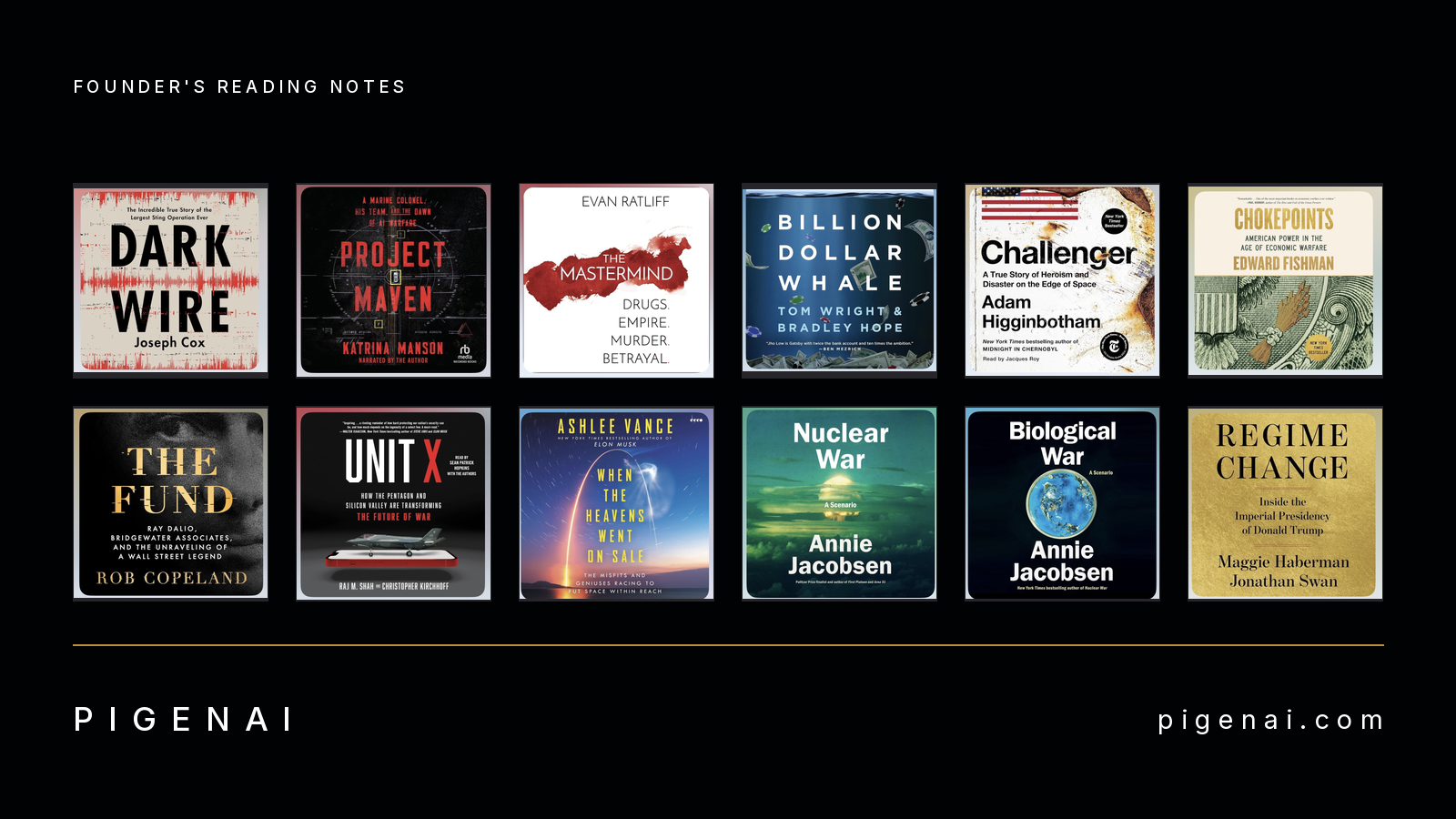
I bought twelve books for my next reading cycle. Only one of them is marketed as an AI book. That is why I chose them.
The consequential questions about artificial intelligence are no longer primarily about models. They are about power. They are about trust, and how it is manufactured. They are about how institutions behave when a system reports success. They are about decision cycles that have compressed past the point where a person can intervene, about asymmetric advantage, and about the distance between what a system reports, what an organization believes, and what the evidence can actually prove.
That last distance is the subject of the four-part essay I published this month, Evidence Over Attestation. This shelf is the reading behind it, chosen before I had read most of it. So this is a reading note rather than a set of reviews. It explains why each book earned its place. The reviews will come as I finish them.
How the dozen was chosen
Four criteria. Narrative nonfiction, because a reconstructed event teaches judgment in a way a framework cannot. A subject in one of four families: power, technology, institutional failure or asymmetric strategy. Momentum, because a book that is not finished teaches nothing. And a question I could carry back to my own work, which is building and operating products for AI governance, AI literacy, security and answer-engine visibility, and holding agents and people to the same standard of proof.
Only one of the twelve is about AI on the surface. All of them are about AI underneath, because each one is about a system that reported green and was wrong, or about someone who read the evidence before the institution did.
Twelve is not nearly enough
Twelve is the next wave. It is not nearly enough, and that is the point of this note. The judgment a founder or a CEO needs in this era, the kind that asks the right question before an agent answers the one it was given, is not built from a dozen books. It is built from a reading discipline that runs for decades and across disciplines, and it is built at least as much from doing.
Behind these twelve is a library of more than 1,600 titles across Kindle and Audible, built over roughly two decades, several hundred of them in business, technology and AI. The number is the least important thing about it. What matters is that the depth and the quality keep rising: the best minds working today, and the classics that have already outlasted several eras of confident reporting. Finding the right book is itself work, and it takes search, focus and discipline. It does not matter how fast you read if you are reading the wrong things. It does not matter how much you read if you are reading merely good things when the best ones were available. The test of a book is whether it accelerates the mindset and the skills a founder needs to serve customers, teams and a business through technology, market and macro questions that now move at agentic speed, while the horizons of the Intelligence Era keep expanding and shifting.
Peter Drucker drew the line this whole note rests on: efficiency is doing things right, and effectiveness is doing the right things. Agents have made efficiency cheap. A fast answer to the wrong question is failure. A slow answer to the right question is leverage. Efficiency perfects the process. Effectiveness questions the premise. The reading discipline exists to keep a founder on the effectiveness side of that line, choosing the question before the machine answers the one it was given.
That kind of reading builds something a dashboard cannot report: a sixth sense, and a seventh, the anticipation that feels a problem before the telemetry shows it. It builds a leader who can be flexible, dynamic and fluid in the moment and still precise, accurate and disciplined in vision and in thought, and who can think, act and feel with authenticity, integrity and coherence, day after day, until the focus produces results.
Reading is the input. Doing is the output. The two have to balance. Beside the reading are more than 50 AI trainings and certifications so far, and beside those is the work the reading is for: hands-on, end-to-end AI operations across a portfolio that spans AI, networking, cloud and security workloads, SaaS, edge and customer experience management, run as companies and brands rather than as demos, with 3.3 million lines of production code across 70 repositories written with agents in nineteen months and counted by a script over the repositories rather than estimated. This note practices what it describes: the reading is listed by title, and the doing is counted rather than claimed.
Input without action is a shelf. Action without input is a gamble. The balance between them is the discipline, and it is the same discipline the essay describes: refusing to take a confident report, from a book or from a machine, as proof.
Evidence and institutional confidence
Challenger, by Adam Higginbotham. The engineers had the evidence. Management had the schedule. An unresolved anomaly was normalized, review by review, until the morning it was not. This is the attestation trap with a launch date, and it is the book on the shelf closest to the essay’s argument: institutional confidence can outrun proof, and the customer, in this case seven people and a nation watching, pays for the gap.
Billion Dollar Whale, by Tom Wright and Bradley Hope. Jho Low moved billions out of a sovereign fund through shell companies and prestigious intermediaries whose presence was, in practice, the verification. Banks, auditors and advisers attested. Nobody proved. It is the clearest account I know of institutional verification failing at global scale, and every one of the failures is a failure of someone accepting a claim in place of an artifact.
The Fund, by Rob Copeland. Bridgewater built machinery to score its people and called the scores objective. The book asks whether judgment was truly systematized or merely encoded, with the founder’s preferences disguised as measurement. That is the question I ask of every dashboard an agent produces, and of every “principles” document a company writes down.
Speed and authority
Nuclear War: A Scenario, by Annie Jacobsen. Seventy-two minutes from warning to catastrophe, with concentrated authority, thin communications and automated retaliation logic doing most of the deciding. Experts dispute the assumptions that keep the escalation uninterrupted, so read it as a stress test rather than a forecast. As a stress test it is exactly the case the essay makes: when the decision cycle runs faster than the judgment cycle, the only question left is who designed the judgment in advance.
Biological War: A Scenario, by Annie Jacobsen. Her second scenario, and the one I have not opened. I bought it for the method. The constructed timeline that made the first book a stress test of authority under compressed time is applied here to a threat that spreads rather than strikes, where the warning is ambiguous for longer and the decisions belong to more institutions at once. That is closer to how most organizational failures actually arrive.
Project Maven, by Katrina Manson. The Pentagon’s effort to move computer vision into battlefield targeting, from Google’s withdrawal to Palantir and operational deployment. It is the most current book on the shelf, and the only one about AI on its face. What I want from it is the texture of model oversight under compressed cycles, where the artifact and the decision arrive at nearly the same moment.
Trust and its manufacture
Dark Wire, by Joseph Cox. The FBI secretly ran an encrypted phone company that criminal networks adopted worldwide. Trust manufactured at the endpoint is not trust. It is a claim, and the people who relied on it never checked the artifact. For anyone building on infrastructure they do not control, it is a study in compromised endpoints and adversarial product strategy.
The Mastermind, by Evan Ratliff. A programmer, Paul Le Roux, assembled a transnational criminal empire from software, encrypted communications, online businesses and compartmentalized operators who rarely knew one another. Distributed architecture became asymmetric organizational power. The same design shows up, for better, in every founder who now runs a company of agents.
Power and asymmetric strategy
Chokepoints, by Edward Fishman. How control over dollars, banks, semiconductors, energy and supply chains became an instrument of state power. Control of an indispensable node is leverage out of all proportion to size. That is the strategic question for every company building inside someone else’s platform, and it is why I do not build products that depend on tools I do not control.
Regime Change, by Maggie Haberman and Jonathan Swan. Two reporters’ account of the exercise of presidential power and of the institutions that met it. I bought it for the institutional question rather than the partisan one, and I will read it that way: what happens to checks, procedures and evidence when authority concentrates in one office, and which institutions hold. It is the same question this shelf asks of machines, put to the oldest kind of concentrated power there is.
Unit X, by Raj M. Shah and Christopher Kirchhoff. A firsthand account of the Defense Innovation Unit moving commercial software, AI, drones and satellites through a procurement system built to resist speed. It is a case study in constructing a bridge for speed inside an institution that distrusts it, told by the people who built the bridge, which is a bias worth reading with.
When the Heavens Went on Sale, by Ashlee Vance. Planet Labs, Rocket Lab, Astra and Firefly try to bring down the cost of satellites and launch. Unconventional builders iterate against capital-intensive incumbents and win only where the engineering survives contact with reality. Speed is not the moat. Surviving the test is.
What the dozen says about AI
The model is one component. The actual system includes incentives, operators, interfaces, institutions, dependencies, authority, evidence and time. An AI system can perform exactly as designed and still produce a disaster if the institution around it cannot question it, verify it or interrupt it. The same technology gives a smaller organization a real advantage when it understands the architecture of power better than the incumbent does.
My own work looks different on the surface from one product to the next: governing how an organization uses AI, teaching AI literacy, producing governance evidence a regulator can check, securing new systems, and keeping companies visible as discovery moves from search engines to answer engines. The underlying problem is the same in each. It is closing the distance between what the technology promises, what the organization believes and what the evidence can prove.
That is why AI leadership needs a broader reading discipline than the AI shelf provides. We need to study intelligence, and also deception. Automation, and also accountability. Speed, and also interruption. Innovation, and also institutional memory. Telemetry, and also evidence.
The notes on each book will follow here as I finish them, with the connections to AI systems, governance and executive decision-making that made me buy them. If you have read any of the twelve, I would like to know which one you would hand a board first.
The dozen
- Dark Wire, by Joseph Cox. The fastest way in: a trust inversion told as a thriller.
- Project Maven, by Katrina Manson. The most current: operational AI in consequential military systems.
- The Mastermind, by Evan Ratliff. Distributed organization as asymmetric power.
- Billion Dollar Whale, by Tom Wright and Bradley Hope. Institutional verification failing at scale.
- Challenger, by Adam Higginbotham. Evidence, normalization and institutional pressure.
- Chokepoints, by Edward Fishman. Power through control of indispensable nodes.
- The Fund, by Rob Copeland. Judgment encoded and presented as objectivity.
- Unit X, by Raj M. Shah and Christopher Kirchhoff. An innovation bridge inside a slow institution.
- When the Heavens Went on Sale, by Ashlee Vance. Iteration against capital-intensive incumbents.
- Nuclear War: A Scenario, by Annie Jacobsen. Automated logic and concentrated authority under compressed time.
- Biological War: A Scenario, by Annie Jacobsen. The same method, applied to a threat that spreads.
- Regime Change, by Maggie Haberman and Jonathan Swan. Concentrated authority and the institutions that meet it.
Related: Evidence Over Attestation, Part One: Why Machine Speed Demands Executive Judgment and the one-page standard.