
Founder’s notes. Trust, transparency and privacy are not one dial. They are three design choices we can make well together.
The question every community is now asking
Key concept: We can build societies that are both more trustworthy and more private, if we stop treating transparency and privacy as opposites.
Every community I work with is wrestling with the same question. How do we build trust and authenticity in a world where content, identities and claims can be produced at machine speed? And how do we do it while protecting the privacy that lets people live, speak and create freely?
It is tempting to see this as a trade. More transparency means less privacy, and more privacy means less accountability. Turn the dial one way and you get surveillance. Turn it the other way and you get a world where no claim can be checked.
I believe the trade is mostly a false one. The communities, companies and institutions that earn lasting trust are not choosing a point on a dial. They are applying a small set of principles that give each side what it needs.
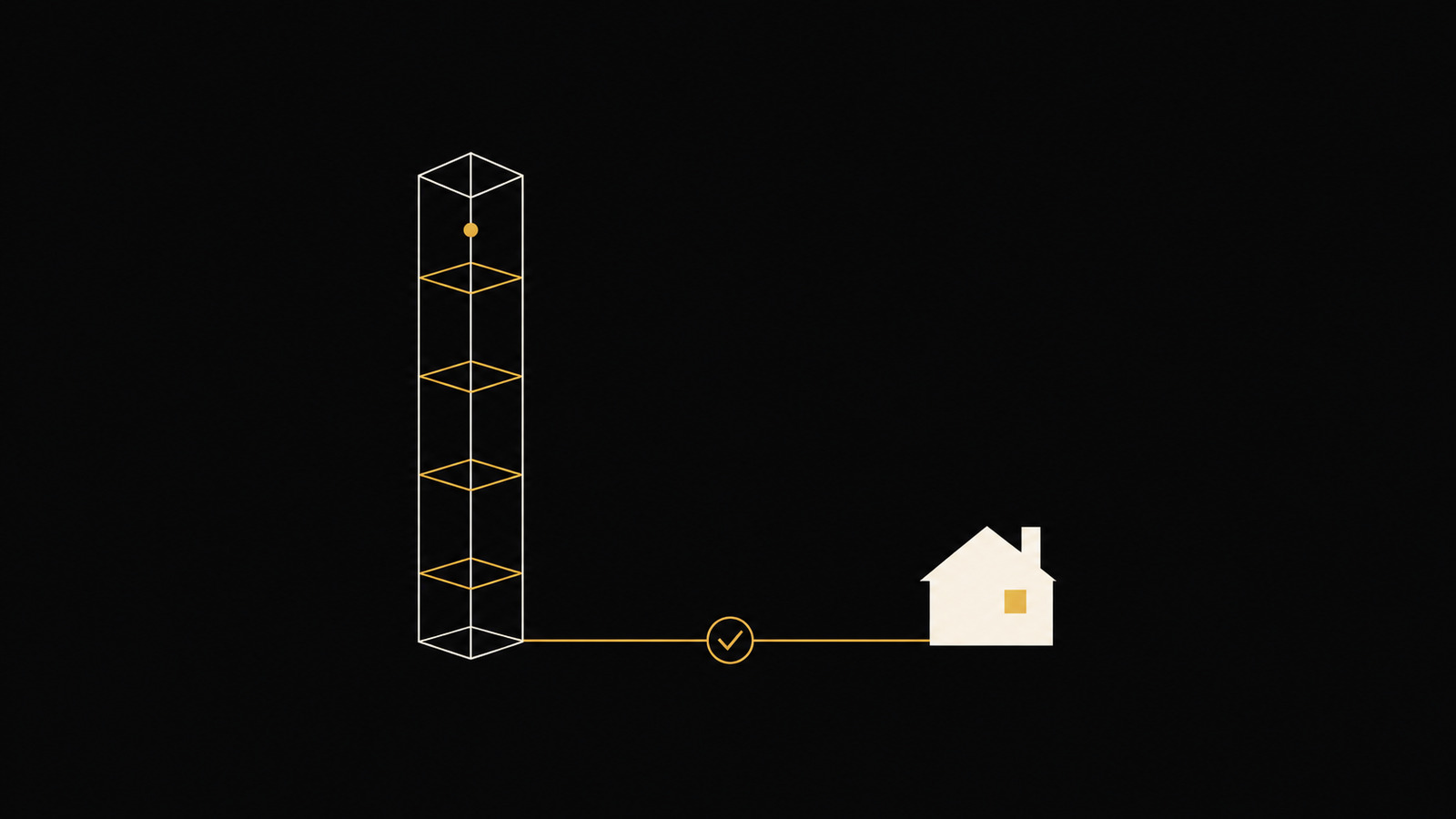
Privacy for people. Transparency for power. Verifiable claims connecting the two.
Principle one: transparency scales with power
Key concept: The more power and public trust someone holds, the more visibility they owe. The more vulnerable someone is, the more privacy they deserve.
Governments, corporations, officials and anyone entrusted with public money hold the most influence over other people’s lives. They owe the most visibility: who owns what, who paid whom, who decided, and on what evidence. Individuals hold the least power, and they deserve the most protection for their messages, movements, health and beliefs.
This asymmetry is what healthy institutions already practice at their best. Public companies publish audited accounts. Elected officials file disclosures. Beneficial ownership registries put a name behind the money. Each of these makes power legible without asking ordinary people to give up their private lives.
Principle two: verify the claim, not the person
Key concept: Trust rarely requires knowing everything about someone. It requires reliable proof of the one thing that matters.
A bartender needs to know you are over 21, not your birthdate or home address. An employer needs to know your license is valid, not your entire history. The tools to prove exactly what is needed, and reveal nothing more, now exist and are maturing quickly.
- Selective disclosure. Verifiable credentials and zero-knowledge proofs let a person prove a fact, such as age, residency or a professional licence, without handing over the underlying data.
- Content provenance. The C2PA standard attaches signed Content Credentials to photos, video and documents, showing where they came from, how they were edited, and whether AI was involved. Camera makers, AI providers and platforms such as LinkedIn already support it.
- Dated access records. Logs that record who accessed what and when, kept where a third party can check them, make access itself accountable.
- Privacy-preserving analytics. Techniques such as differential privacy let a city or health system learn from data without exposing any single person.
This is the same idea at the heart of Evidence Over Attestation. A signed record of what happened is worth more than a promise that it happened.
Principle three: institutions that correct themselves
Key concept: No system is perfect, so the best systems are the ones that notice their mistakes and repair them.
Karl Popper made this point decades ago in The Open Society and Its Enemies. The aim is not to find perfect leaders. It is to build institutions that can catch errors and change course peacefully. Technology helps, but people and institutions carry the weight:
- Independent journalism and protected whistleblowers who can surface what others miss.
- Courts and auditors with the authority to act on what they find.
- Bounded powers with warrants, oversight, transparency reports and sunset dates, so extraordinary authority is reviewed and renewed rather than assumed.
- Reversibility in decisions, data collection and AI systems, so they can be audited, appealed and switched off.
The Panama Papers are the clearest recent example. A small group of people with good evidence and strong institutions behind them made a very large difference, and the people whose private lives were never the subject stayed out of it.
Making honesty the easy path
Key concept: People follow incentives. When verification is cheap and fraud is costly, integrity becomes the default.
AI makes this moment unusually important. The same capabilities that can generate convincing content at scale can also trace, match and verify at a cost that was unimaginable a few years ago. Which way it tips depends on choices we are making right now in product design, policy and education.
For leaders, a few practical steps make a real difference:
- Ask for proof, not assurances. In procurement, partnerships and AI deployments, request evidence that can be checked: signed logs, audit trails, provenance records.
- Collect less, prove more. Design products to verify the specific fact you need instead of gathering data you will have to protect.
- Label what your AI creates. Attach Content Credentials to generated images and media so your audience can see their origin at a glance.
- Build in reversibility. Make sure every automated decision can be explained, appealed and switched off.
- Teach judgment. Invest in the critical thinking of your teams and communities. Knowing how to ask a good question and check a claim is the most durable safeguard we have.
There is no permanent utopia. There is a society that keeps getting better because it can see its mistakes and fix them. Privacy for people, transparency for power, and verifiable claims connecting the two give us a practical path toward that society, and the tools to walk it are already in our hands.
Trust is not the absence of doubt. It is the presence of evidence.
A line I have been using for a while. If someone said it first, I would like to credit them.
Related: Evidence Over Attestation, Part One and AI Did Not “Colonize” Us. But Humans Did Lose Containment.